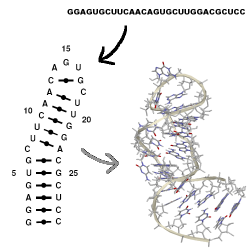
RNA secondary structure prediction from sequence, with non-canonical base pairs
MC-Fold help
MC-Fold predicts RNA secondary structures from sequence using nucleotide cyclic motifs (Parisien & Major, Nature 2008). Results are identical to the original MC-Fold web service.
Sequence
Up to 150 nucleotides. Upper or lower case is accepted; T is read as U.
Dashes, underscores and spaces are ignored. Modified-nucleotide symbols accepted by the original MC-Fold are also accepted.
Algorithm options
- H-type pseudoknots: also consider H-type pseudoknotted structures (slower).
- Return the best N structures: number of structures listed in the results.
- Explore the best X % sub-optimal structures: energy window explored around the optimum. Larger values are slower.
Structural constraints
A mask of the same length as the sequence: ( ) paired, . unpaired, * unconstrained.
Check “convert” to turn all . into *.
Reactivity data
Masks of the same length as the sequence marking reactive nucleotides with x. High, medium and low reactivity add
+8, +4 and +2 kcal/mol penalties respectively when the nucleotide is paired.
Results
Each job gets a private link that stays valid for 30 days. The results page lists the best structures with their energies (kcal/mol), a base-pair consensus, the best structure in CT format, and the structures found for each number of stems.
Seeing and saving structures
Each structure in the results has a Display button. It opens a drawing of the structure: stems as ladders,
loops as circles, letters and numbering every 10 nucleotides. Previous and Next move through the same table;
Arcs shows the structure on one line with the pairs as arcs (used first above 1,000 nucleotides, where loop drawings
may overlap); zoom with the buttons, the mouse wheel or two fingers, and move the drawing by dragging. Pseudoknot pairs
([ ]) are drawn as orange curves and non-canonical pairs written < > as blue dashed lines.
Save SVG gives a vector image (for editing or printing at any size) and Save PNG a high-resolution
picture; both include a caption with the name, structure number and energy. Drawings are made in your browser: nothing is sent elsewhere.
Base-pair consensus
Under a list of N structures, MC-Fold prints one line per threshold from 50 % to 100 %. For each base pair it counts the structures of the list that contain it, and marks the pair on the line if that count is at least threshold × N / 100, rounded down. Three consequences:
- With few structures the thresholds are lower than their labels: with 2 structures, every line from 50 % to 95 % shows the pairs found in at least one structure; with 3 structures, 50–65 % means at least one and 70–95 % at least two.
- Pairs from different structures are written on the same line. When a nucleotide pairs with different partners in different
structures, the line mixes them and may not be a valid structure (for example more
(than)). - Every structure counts the same, whatever its energy.
The lines are shown as MC-Fold computes them (the results must stay identical to the original program). The most reliable reading is the highest threshold that still shows pairs, with the number of structures in mind.
Structures by number of stems
MC-Fold searches with 1 stem, then 2 stems, and so on. After each step it lists the best structures found so far, with up to that number of stems, within the explore range and the number of structures requested. Each section says how many structures were found with exactly that number of stems, how many with up to that number, and how many of those are listed.
Scripted access
Links and scripts using the original address
/cgi-bin/MC-Fold/mcfold.static.cgi?sequence=…&top=…&explore=… keep working.